
KHALISTAN EXTREMISM MONITOR
A project of the Institute for Conflict Management
A project of the Institute for Conflict Management
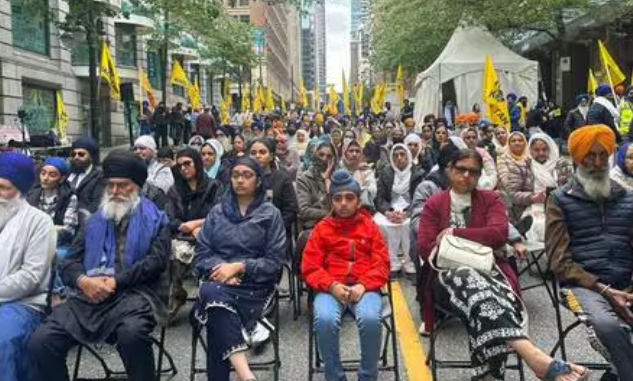
Canada’s House of Commons observed a “moment of silence” on Tuesday to
mark the first anniversary of the killing of pro-Khalistan figure Hardeep Singh
Nijjar. The day also witnessed a large protest in front of India’s consulate in
Vancouver, which featured, among other posters, those showing the person
considered the mastermind of the bombing of Air India flight 182 in June 1985,
the Kanishka, the worst incident of terrorism in Canadian history.
The observation in the House over the “assassination” of Nijjar, who was
killed in Surrey, British Columbia on June 18 last year, was announced by
Speaker Greg Fergus following an “agreement” on it across party lines.
Pro-Khalistan
elements also marked the day, as many gathered in front of India’s consulate in
Vancouver to protest the killing of Nijjar a year ago.
“Indian
ministers and diplomats who will escape Canadian justice will certainly face
Khalsa justice as pro-Khalistan Sikhs will ‘Haunt, Hunt and Hold’ killers of
Nijjar responsible under the international laws,” Sikhs for Justice
general-counsel Gurpatwant Singh Pannun,said.
“You
can hide behind the diplomatic immunity for some time, but cannot be protected
for lifetime,” he added.
He
also called for a boycott of Air India from June 23. That date marks the 39th
anniversary of the Kanishka bombing by Khalistani terrorists. The terror attack
claimed 329 lives, including those of 86 children and is observed in Canada as
the National Day of Remembrance for Victims of Terrorism.
On
display at the protest in front of the Vancouver consulate were posters with
the image of Talwinder Singh Parmar, who is considered the mastermind of the
terror attack.
Pannun
had called for a similar boycott in November last year but that had little
impact on the airline’s services from Canada.
In
a post on X, the Indian consulate referred to that tragedy describing it as
“one of the most heinous terror-related air disasters in the history of civil
aviation”.
It
added, “India stands at the forefront of countering the menace of terrorism and
works closely with all nations to tackle this global threat.”
Nijjar’s
murder has caused relations between India and Canada to crater, after Prime
Minister Justin Trudeau’s statement in the House of Commons on September 18
last year that there were “credible allegations” of a potential link between
Indian agents and the killing. In May this year, four Indian nationals were
arrested in connection with the crime. Canadian law enforcement has yet to
provide details of any Indian involvement but have said those investigations
are ongoing.
India
had dismissed Trudeau’s allegations as “absurd” and “motivated” last September.
Nijjar
was considered a terrorist by India but none of the charges against him were
tested in a Canadian court.