KHALISTAN EXTREMISM MONITOR
A project of the Institute for Conflict Management
A project of the Institute for Conflict Management

The government of Pakistan's Khyber Pakhtunkhwa province on June 22 announced a grant of PKR 40 million for a gurdwara in Mardan district and compensation of PKR 1 million each for the families of a Sikh couple who were shot dead inside the place of worship. Provincial Minister for Religious and Minority Affairs Sahibzada Adnan Qadri visited the gurdwara, expressed solidarity with the Sikh community, and condemned the killings.
Police on June 18 arrested Sher Shah, the prime suspect in the double murder of a Sikh caretaker couple who were shot dead at a gurdwara in Khyber Pakhtunkhwa province in Pakistan on June 17. According to police, investigations have so far found no evidence linking the accused to any banned outfit, terrorist organisation, or organised network.
A Sikh caretaker couple, Jagannath and his wife Asma Wanti, were shot dead inside a gurdwara in the Babu Mohallah area of Mardan, in Khyber Pakhtunkhwa province in Pakistan on June 17. According to Mardan District Police Officer Masood Ahmed, unidentified assailants opened fire inside the gurdwara, killing the couple. Police have launched an investigation and are working to determine the motive behind the attack and identify those responsible.
On April 29, marking the 40th year of the Khalistan Declaration, Sikhs For Justice (SFJ), speaking from the Karachi Press Club in Pakistan, announced the launch of Khalistan Referendum voter registration for Sikhs in India. The group issued a message reaffirming what it described as a global Sikh commitment to the “liberation of Punjab” and the establishment of Khalistan. SFJ chief Gurpatwant Singh Pannun claimed that Pakistan’s response to India had enhanced its global standing, alleging that recent developments had positioned the country as a rising power. He also stated that Field Marshal Asim Munir had emerged as a voice for peace during the US-Iran tensions, and asserted that former US President Donald Trump had acknowledged his role on multiple occasions.
According to reports, pro-Khalistan activists disrupted an outreach consular event organised by the Indian High Commission in Sutton, South London, United Kingdom (UK), last weekend. The activists reportedly entered the venue—a primary school building—waving Khalistan flags, confronted organisers, and objected to the event, arguing that Indian officials had no right to hold it there. They also raised pro-Khalistan slogans and demanded access to the visiting officials. The all-day event, organised by Indian Friends of Sutton, was intended to assist members of the Indian community with passport renewals, Overseas Citizen of India (OCI) cards, and visa-related services. Approximately 500 people attended the programme. Reports further indicated that a Tamil-language class for children was underway in another part of the building when the disruption occurred.
Indian-origin restaurateur Harman Singh Kapoor has been arrested days after announcing the closure of his 16-year-old restaurant Rangrez in the United Kingdom (UK), citing threats from Pakistani individuals and a lack of support from the police. Responding to a post on social media, Kapoor confirmed his arrest but did not disclose the exact reason. He stated, “All I did was protect my family, yet I was the one arrested. Instead of protecting us, the police targeted my religion—my Sikh faith and my beliefs. This is deeply troubling.”
An Indian-origin drug dealer, Naginder Gill, was sentenced to 20 years’ imprisonment by Bolton Crown Court in northwest England, United Kingdom (UK) on January 29 for plotting multiple firearms and drug offences. Using the EncroChat handle “indianoceon,” Gill conspired with Carl Ian Jones and Harly Wise to trade military-grade weapons. Jones was sentenced to 30 years and Wise to 25 years in the same case, following an investigation by the UK’s National Crime Agency (NCA).
According to reports, pro-Khalistani activist Paramjeet Singh Pamma was advised by United Kingdom (UK) police to install security cameras and reinforce door locks at his residence following alleged threats from Hindu nationalist elements, raising renewed concerns about transnational repression on British soil. Pamma stated that police had visited him and issued verbal security advisories based on intelligence inputs indicating potential threats to his safety. He further accused UK ministers of failing to take what he described as “relentless” transnational repression by India seriously.
Participants:
Participants:
Participants:
Participants:
The Air India Flight 182 Kanishka on June 23, 1985, flying from Toronto to Mumbai, exploded in mid-air over the Atlantic Ocean off the coast of Ireland killing all 307 passengers and 22 crew members. The mid-air bomb explosion which killed all the 329 persons, including 268 Canadians, 27 British, 22 Indians and 12 others on board, was the deadliest attack on civil aviation until the September 11, 2001 attack in neighbouring USA.
At least 50 passengers were killed and another 30 persons were injured as terrorists belonged to Khalistan Liberation Force (KLF) attacked the train passengers in a train at Baddowal village in Ludhiana District on June 15, 1991. When the train was stopped as someone pulled the ‘emergency cords’ at Baddowal on the Ludhiana-Ferozepur railway line, the terrorists entered into the train’s compartments and started firing at the passengers.
Khalistani terrorists attacked a passenger bus and killed 38 innocent civilians and injured another 33 others on July 6, 1987, near Lalru village in Mohali District of Punjab. Around a half dozen terrorists belonging to Khalistan Commando Force (KCF) forcefully stopped a passenger bus - Haryana Roadways bus HYE 1735 – near Lalru village (between Jamalpur and Hasanpur villages) and opened fire on passengers, killing 38 passengers including women and children.
On July 1, Punjab Police, on day 487 of its “Yudh Nashian Virudh” campaign, arrested 87 drug smugglers, and seized 1.8 kg of heroin, 401 intoxicant tablets/capsules and INR 1,112,000 drug money from the possession of arrested persons, across the state.
According to police, a search of jail warder Robinpreet Singh led to the seizure of 79.40 grams of opium, 41.18 grams of a black narcotic substance, 93.32 grams of white narcotic powder, 215 grams of tobacco, 205 ml of an intoxicating liquid, and an Apple touchscreen mobile phone, inside the Central Jail in Amritsar district. During preliminary investigation, the name of an inmate, Rahul Kumar, also surfaced, with police suspecting the existence of an organised network involved in smuggling drugs and other prohibited items into the jail.
On June 30, Punjab Police, on day 486 of its “Yudh Nashian Virudh” campaign, arrested 19 drug smugglers, and seized 354 grams of heroin, 20 intoxicant pills and INR 620 drug money from the possession of arrested persons, across the state.


A Red Corner Notice (RCN) was issued against Gurpreet Singh by INTERPOL in October 2019 for his criminal and terrorist activities.


INTERPOL had issued a Red Corner Notice (RCN) against Balwinder Singh for several charges including being member of terrorist organization, raising fund for terrorist organization etc.


INTERPOL issued a Red Corner Notice (RCN) against Gurjinder Singh Pannu in 2019 for various charges including raising funds for terrorist act.


INTERPOL has issued a Red Corner Notice (RCN) against Khalistan Liberation Force (KLF) leader Harmeet Singh alias PhD alias Happy in 2019.



An on-stage disruption briefly shocked audiences at Diljit Dosanjh's concert in San Francisco on Friday after a pro-Khalistan demonstrator jumped onto the stage holding a flag. The incident caused panic for a short while before venue security and local police intervened, tackled the individual and took him into custody.
In an intelligence-led operation carried out with the support of central agencies, the Punjab Police has secured the deportation from Malaysia of two wanted operatives linked to the banned Khalistan Zindabad Force (KZF) terror module accused of targeting critical railway infrastructure, including the Dedicated Freight Corridor lines in the state.
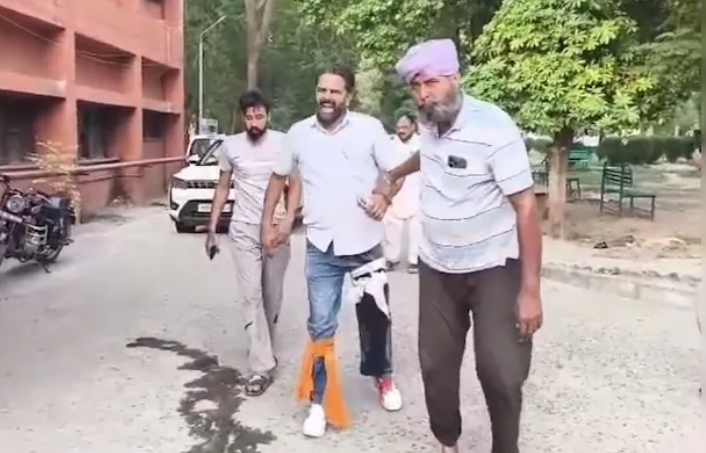
In a shocking incident, a village sarpanch and Aam Aadmi Party (AAP) leader was critically injured after being shot at by unidentified assailants in Punjab's Gurdaspur district.
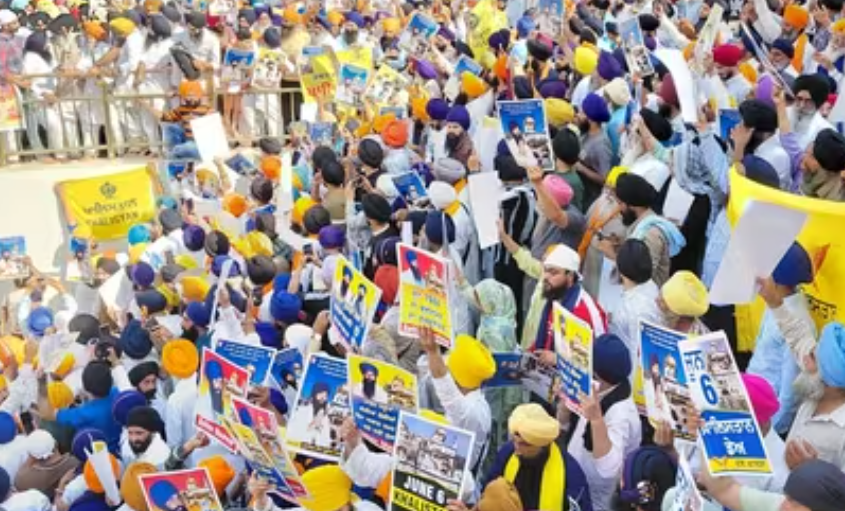
The 42nd anniversary of Operation Blue Star, the Indian army mission to clear extremist elements from the Golden Temple in Amritsar in 1984, saw pro-Khalistan slogans being raised inside the premises of the holiest Sikh shrine on Saturday.