
KHALISTAN EXTREMISM MONITOR
A project of the Institute for Conflict Management
A project of the Institute for Conflict Management
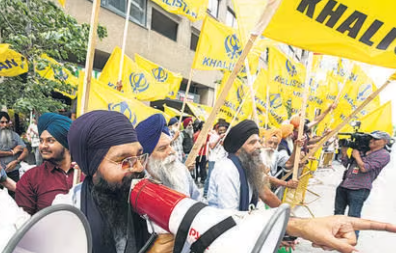
Two Khalistani protesters were apprehended by police as violence broke out at pro- and anti-India rallies outside the Indian Consulate in Toronto on Saturday.
Around 250 Khalistani supporters had gathered across the street from the building housing India’s consulate for a protest rally, which was backed by secessionist group Sikhs for Justice or SFJ, and had been publicised through online circulation of the infamous “Kill India” posters targeting India’s senior diplomats in Canada.
The pro-Khalistan group was countered by a pro-India rally at the spot across the street. The two sides were separated by Toronto Police personnel, even as barricades were erected to restrain the protesters and the section of Bloor Street, where the building is located, was blocked to traffic.
The pro-Khalistan group attempted to breach the barricade and storm the pro-India contingent, but were pushed back by police. As one protester rushed ahead, he was thrown to the ground and subdued, and taken away by police.
A second protester was also apprehended for allegedly assaulting a police officer on duty. The entire standoff lasted for three hours.
A spokesperson for Toronto Police, in response to an emailed query from Hindustan Times, said both the protesters were released later without charges.
At the protest, the pro-Khalistan group held posters of SFJ leader Hardeep Singh Nijjar, who was shot by unidentified gunmen in Surrey, British Columbia, on June 18. The posters alleged the Indian establishment’s role behind the murder.
Other posters promoted the next phase of so-called Punjab Referendum in Greater Toronto Area or GTA on July 16. Some of the protesters wore jackets bearing the legend Republic of Khalistan and an image of an AK47.
The pro-India group did not flinch despite being outnumbered. As the group was dispersed by police amid light rain, one of them, Arvind Mishra, said: “We were successfully able to demonstrate resistance to the Khalistanis. These Khalistanis continue to violate the limits of freedom of speech.”
Another pro-India demonstrator, Neel Sehgal, said: “The violent side of the Khalistanis was exposed when one of them broke through the police barricade to try and attack our gathering.”
Sehgal called upon Canadian Prime Minister Justin Trudeau and his government to “act swiftly and firmly to immediately ban such violent rallies and referendums.”
Besides Toronto, protests by Khalistani supporters were also held in Ottawa and Vancouver, although on a smaller scale. Around 30 protestors gathered across the road from India’s high commission in Ottawa but the agitation was peaceful. The protest in Vancouver attracted about 50 protesters and passed without incident.
With security heightened in all three cities, Canadian authorities appeared to be “responsive” to “some of our sensitivities”, an Indian official said.
Police presence was enhanced at various locations in Canada after a set of posters, titled “Kill India”, originally targeted India’s High Commissioner to Ottawa Sanjay Kumar Verma, Consul General in Toronto Apoorva Srivastava and Consul General in Vancouver Manish. Similar posters were also released for the US, UK and Australia.
The SFJ has also threatened to “besiege” the Indian mission in Canada on August 15.
Early on Friday, a poster titled “War Zone” and targeting Indian diplomats in Canada surfaced outside Bharat Mata Mandir in Brampton. The poster was later removed by the temple authorities.
Canada’s Minister of Foreign Affairs Mélanie Joly had described the posters as “unacceptable”. Minister of National Defence, Anita Anand, had tweeted, “Canada will continue to ensure the safety of foreign diplomats in this country – and we take this responsibility seriously.”
Earlier, India was particularly irked by Canada’s response to activities of pro-Khalistan groups, and Canadian envoy Cameron Mackay was summoned to the external affairs ministry July 3 and served a demarche over the threat to Indian diplomats.
“Our sense is that these posters inciting violence against our diplomats and our diplomatic premises abroad are unacceptable and we condemn them in the strongest terms,” external affairs ministry spokesperson Arindam Bagchi said on Thursday.
Nijjar was believed to be the head of the Khalistan Tiger Force by Indian law enforcement agencies and faced several terror-related charges. He was the principal SFJ figure in the Metro Vancouver region.
The National Investigation Agency had announced a reward award of ₹10 lakh for information leading to Nijjar’s capture. None of the charges against him were tested in Canadian courts and SFJ has maintained it does not resort to violence.